Pages

Wednesday, 1 July 2015

15mm.co.uk Automata

As much as I expect the new Terminator film to be a disappointment, it has at least got me thinking about doing some Terminator gaming... Although I was tempted by the new game by River Horse, I ended up deciding that I really don't need to start another 28mm project (but I came very, very, close...)

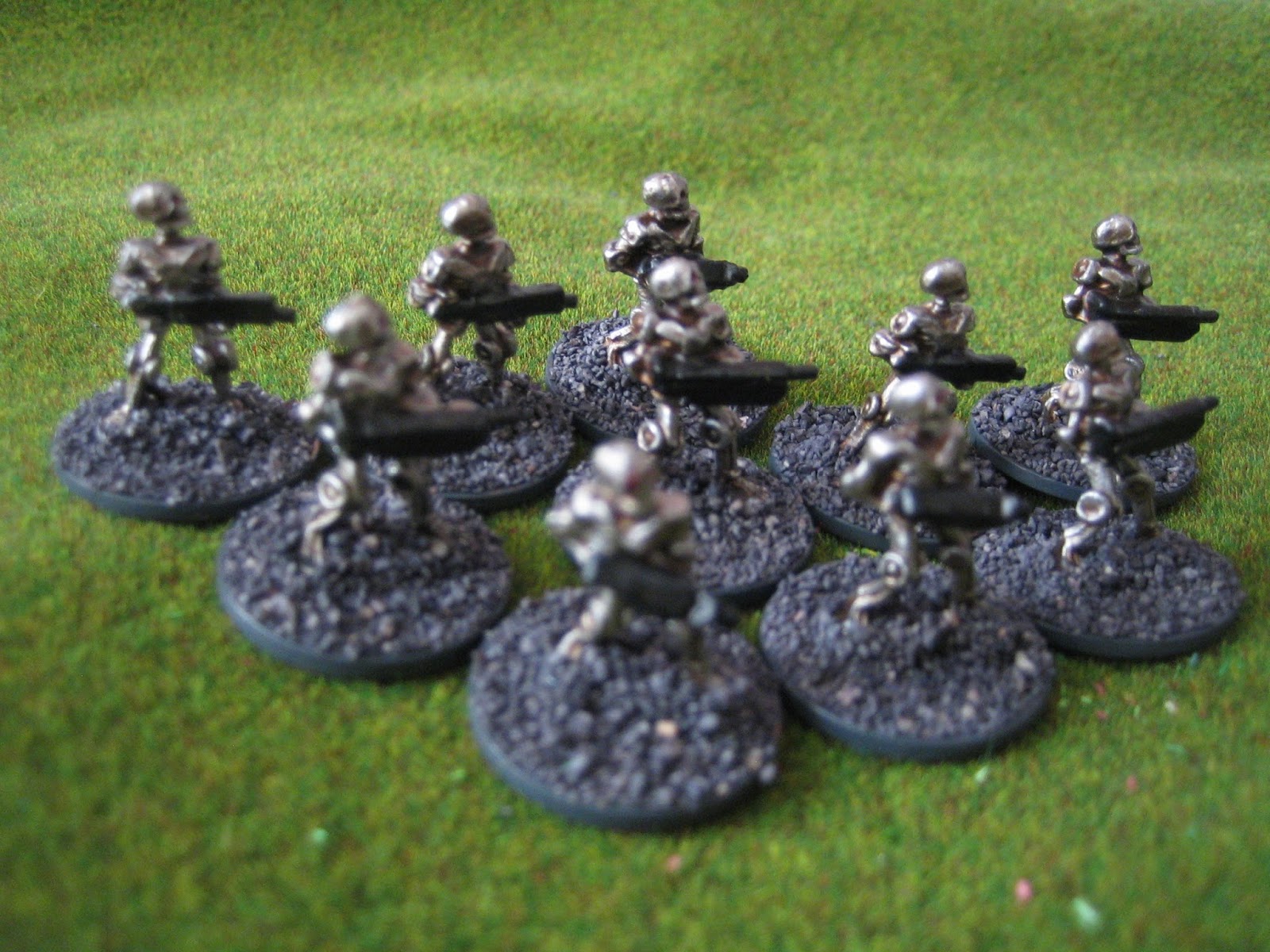
Instead, I thought it was time to do something I've been meaning to do for a while and get hold of some of the Automata Infantry from 15mm.co.uk.

I think these are some of the best out there for Terminator games in 15mm. Sure, they may not be 100% identical, but why would they be? What is important for me is that they look close enough from a distance and I think these do.

Here is the pack after a quick paint job:

I really need to sort out the focus on my camera... :(
As a bonus, they will work well in a number of 15mm projects I have in the pipeline, including Judge Dredd and Rogue Trader. So all in all I think they are well worth getting hold of and £4 for a pack of 10 isn't too bad a price.

To end, here's a better close up picture.


Wednesday, 24 June 2015

A look at: Patrol Angis

Recently I have been scouring the web for information on Patrol Angis, the new set of rules from Gavin and co at The Ion Age. I was intrigued by the description of the rules and the setting but could not find a great deal more than what was on the website. So naturally I thought 'what the heck, they are only £10' and bought a copy! To make up for the lack of information available, I thought I'd give my initial thoughts here.

The Book

The book itself is a very well presented A5 size publication with full colour cover and black and white images inside. It has seriously started to make me wonder why more rules are not this size! It means they can easily be rested on the table during a game for quick reference and it also makes them easy to handle or hold in one hand while the other one is rolling dice or holding a refreshing beverage. Good thinking, chaps!


The Background

The first 20 or so pages of the book deal with the background to the setting, which could be described in a nutshell as being the Wars of the Roses in a Space Opera setting. While the rules could be used with other miniatures, the setting and content of the book is obviously geared to the Ion Age range. What is different about this book is that, while my usual inclination is to discard the fluff and just play with my existing figures, reading this particular background has really got me wanting to play the rules with the Ion Age figures and in the Ion Age setting. I really wasn't expecting to feel that strongly, but the background in the book is highly interesting and different to other things I have read.

Force Organisation 

The rules say they are aimed at each player having a platoon sized force. This immediately made me think of three squads plus a command group on each side, but I was wrong! While this gives an idea of the number of figures you might expect to field, you actually have quite a lot of flexibility in how your force is organised. You can choose to deploy in squads, sure, but you can decide to split your squads into fire teams or even smaller units if you wish. So there is actually a good amount of decision making in terms of how you wish to deploy your platoon and you would want to think a bit about how you might use your options to achieve your objectives.

The elements you decide to deploy are organised in a fixed way, as shown by the picture of suggested movement trays:


It should be noted that this book contains rules for infantry, power armour and infantry-sized vehicles, such as bikes. Larger vehicles and how they fit into the force structure will be covered in a  future book.

Core Mechanics

Unusually for a game of this type, the core mechanic is an intriguing command and control mechanism. Initiative is a d6 roll, but the higher roll determines how many activation tokens are received by each side. The side which loses initiative gets the number shown on the die, the winning side gets that number plus one. So if the initiative roll was 3 and 5, the side which won gets 6 tokens and the side which lost gets 5. A good way to give a little edge to the winner without being overpowering.

Starting with the side that lost initiative, players then take it in turns to place an activation token next to an element in their force. Unless specified, an element can be assigned any number of tokens during this process. This is an interesting mechanic which leads to you trying to out guess and out plan your opponent before you have even touched a miniature!

During the main part of the turn, starting with the side with initiative, the player removes an activation token from an element and chooses what that element will do. There are no less than 11 (well, 10 and the option to pass!) choices to select from and these cover moving and firing, rapid moving, precise firing, overwatch, reorganisation, recovering morale, digging in for self protection and lots more. To add to this, elements which are fired upon can also use activation tokens to negate hits against them, so you may have to make a tough choice about taking casualties or keeping your head down for a turn, which in effect is a neat little pinning mechanic!

Now let's be clear, fire combat in this game can be pretty deadly! All rolls to hit are made with a d8 and have a basic target of 2+. That's right, there is only a 1 in 8 chance of missing a target in the open! Of course, terrain modifiers come into play and each item of terrain provides a bonus from +1 to +3 depending on how much of the LOS crosses it. If there is terrain along more than 10cm of the LOS then no fire is possible. The max terrain modifier is +4. So terrain starts to be rather important in this game! Any hit figures can make an armour save roll, which is a 4+ modified by the armour worn and the penetration of the weapon.

Taking casualties results in the need to make morale tests. Failing a test results in the loss of an activation token if the element has one, or the gain of a 're-motivation' token if they do not. The re-motivation token has to be removed with an activation before any other action can be taken.

Lets not forget that you only get between 1 and 7 activation markers each turn (skewed toward the high end as the winning roll determines the number). So if your force consists of smaller elements then you have some tough choices to make when allocating them. And it gets even harder when morale checks force you to remove them or waste one next turn to re-motivate an element.

Other Rules

After the main rules section, there are a couple of pages outlining a series of special rules which may apply to units, covering things like jet packs, medics, snipers and special gear. There is also a section on solo play, which will be largely familiar to players of Flintloque. Then there are 10 pages of stats for the various forces available and some 'fluff' on the types of weapons and armour available. The book ends with some brief designer's notes and some additional background which outline the 'rules' of the setting in terms of why certain technology exists and why the universe works the way it does.


My Thoughts

I have to say I wasn't sure what to expect from this book. I was expecting something solid, fun and playable. What I found when I read the rules was all of those but arranged around a command and control system that I have not come across before in a sci-fi rule set and some nicely brutal combat rules that punish commanders who think acceptable battle strategy is advancing across open ground.

I also found myself really getting drawn into the background and enjoying it, it manages to feel 'fun' but also have a nice amount of detail to it.

My only slight criticism at this point would be that I found some of the rules sections to be a little unclear. My questions were answered by the examples, however, so there were no problems left after I had read them, although I prefer examples to be optional rather than required reading. But that is a minor point in an otherwise excellent looking set of rules.

There is a lot crammed into the 64 page book and the rules themselves do not take up a massive amount of it (about 17 pages for the core rules). But at the same time I am left with the feeling that they present a lot of tactical challenges in a deceptively simple package.

I have often described rules by this designer as being quite 'old-school'. In this case I don't think that is true at all. I think these are a modern set of rules which will let players fight 'old-school' type battles they way they remember them being rather than the way they actually were (i.e bogged down in loads of die rolls and endless charts and tables!).

I would highly recommend these rules to anyone who is either drawn to the accompanying miniatures range or interested in a more tactically challenging sci-fi game which is still simple to play.


Sunday, 31 May 2015

A look at: Typhon


Typhon is Alternative Armies' game of skirmishes and heroism during the time of Greek Myth. Players lead a band of Heroes, Shades of Hades or Mythical Monsters in legendary battles, calling on their patron gods to aid them and hopefully surviving enough encounters to grow into a hero worthy of being remembered for generations to come!


Overview
Mechanically, the rules are similar to the Darkestorme fantasy skirmish rules (which I have looked at here), but are modified to both suit the period and improve on the aforementioned publication.


The book itself is an A4, spiral bound tome of 78 pages with clear plastic covers front and back. It's actually quite nice to have a book that lies flat on the table with no need to bend it back or break its spine!

Opening the book, the reader is greeted by a map of Ancient Greece, a brief overview of the game and a generous background of 12 pages outlining the myths and legends of Greece. Useful if you are new to the period or want a quick overview.

Following the introduction are the rules of play, how to create your hero and his followers, advice on scenario creation, an extensive list of powers and gifts, stats for warriors and the monsters they may face, a set of three scenarios and finally record sheets for your heroic band.

Rules of Combat
The core rules are relatively simple in their execution. Characters have two or three actions per turn, which can be used to move, fight, use a god power or carry out other tasks suitable to the scenario. To attack a foe requires a 2d6 roll meeting or exceeding the attacker's 'To Wound' score (usually between 6 and 9). If hit, the defender can make a Resist Wound roll in a similar way.

Where these rules differ to Darkestorme (and are much better, in my opinion) are the way shields, armour and wounds are handled.

If a character carries a Hoplite Shield, he may use it to block the attack. This requires a 2d6 roll and can result in the attack being negated or reduced in strength, or the shield becoming damaged or broken. Other shields merely provide a modifier to Resist Wound rolls and this provides a neat way to differentiate Greek Heroes and their ability to shield against attacks. This is also a more interesting roll to make than your typical d6 roll against a target number.

Armour works in a similar way, with a 2d6 roll on a table. My favourite entry is the roll of a 12 breaking the attacker's weapon! Other results allow various degrees of stopping power or damage to the armour. Both this and the results of using a Hoplite Shield can give a range of modifiers to the defender's Resist Wound roll.
In my opinion this is more interesting to play out than the rules in Darkestorme, but of course it is a little more time consuming. This level of detail is a welcome addition to rules more geared towards skirmishes with only a few figures on each side though. And from a game play perspective it is enjoyable to have the excitement of these rules (usually accompanied by cheers or groans depending on the outcome!).

If an attack scores a wound a roll is required to find out the effect. Monsters just have a flat number of wounds and are defeated if reduced to zero. Characters in Typhon , however, have no such thing! Instead they might be killed outright, mortally wounded and need the assistance of their fellows, avoid the wound entirely, or receive a flesh wound which gives a penalty to future rolls on the table. The table is weighted towards the character being out of the game, but as two of these options allow for the character to return to future games if his side wins, it greatly adds to the tension of the remaining battle!

Additional rules for combat provide for the use of missile weapons, using two weapons at once, having a terrain advantage and making sweeping attacks which can target more than one foe.

Your Hero also has access to Fate points, which can be used to modify initiative rolls or force re-rolls by your opponent.


God Powers
God powers are a major part of the game, so I thought they deserved their own section in this review! When you create a hero, you choose a patron god which allows the hero to have access to that god's powers in addition to a  generic set of gifts that heroes can choose from. Six gods have powers listed in the rule book (two more are available as free PDFs from the publisher). Each god has seven powers of varying potency, reflected in the amount of fate points required to 'buy' them. The generic list of gifts contains an additional 29 powers, for a total of 71! It is quite a list and very thematic compared to your usual list of skills and abilities, serving to reflect how important the gods and their patronage was to the Greek heroes.

All of these gifts are classified as either Items, Powers or Creatures. Generally speaking, Items have an ongoing effect for the whole game, Powers can be used once per game for their effect and Creatures represent some kind of summoning ability which results in the summoned entity coming into play for a certain number of turns or for the whole scenario depending on how powerful they are.
All of the powers really enhance the theme of the game and it add a great variety to the Heroes in the game as well as an interesting decisions in campaigns about whether to gather several minor powers or save up for some of the more powerful ones.


Hero Creation and Campaigns
Before playing, you need to create your band of Heroes, or if you are so inclined, your drove of Shades from Hades. This is a pretty straight forward process. You start with 50 fate points and with these you need to select your Hero and his god powers. A minimum of 40% of your fate points also have to be spent on Champions and Fighters to follow your hero. Costs for all characters vary depending on if you choose Youth, Man, or Aged characters, each of which have a different stat line and differing advantages and disadvantages along with it. Shades are worked out similarly, but have a choice of being Lesser or Greater rather than the three ages.

Once you have chosen your band, you receive a random number of coin with which to purchase weapons and armour, as well as other useful items for campaign games.

The campaign rules as presented in the book are quite a simple affair. Your Hero and Champions gain Fate Points by defeating enemies, winning scenarios and so forth. These can be kept to spend during the game, or used to buy new god powers. You can buy new warriors to join your band or, if they have proven themselves, advance a Champion to the class of Hero.


Monsters
A selection of monsters, most well known from Greek Myths and some less well known, have rules provided in the book. You can also get free PDFs of additional ones from the publisher. These are fearsome foes indeed and suitably challenging for experienced bands of warriors. As well as the kind of stats you might expect from such monsters, they also come with unique abilities that really capture their individual 'flavour'. In a very nice touch, defeating certain monsters allows a Hero to benefit in some way, for example using the teeth of the Cadmus Dragon to raise undead warriors, or the head of a Gorgon to turn enemies to stone.

Miniatures
This is a review of the rules, not of figures, but it is worth pointing out that Alternative Armies stock a range of 'Heroic Scale' figures to accompany these rules, nominally 50mm but I think some 42mm ranges would be compatible (although I have yet to verify this). Of course, you can use whatever range of figures you want with the rules, but I find these have a certain charm about them that I find very appealing. The picture below shows two Typhon figures next to the silhouette of a 28mm Flintloque miniature.


Conclusion
These rules take mechanics from a generic fantasy skirmish game and, with the odd tweak and adjustment, turn them into something that feels quite different. In fact I'd have to say I prefer them to the set they were based on. At their core, the mechanics are pretty simple, but there is so much flavour layered on top that it doesn't feel this is detrimental when playing. I can't say I have played other rule sets for the 'period', otherwise I could offer some kind of comparison. But what I can say is that I don't feel the need to rush out and buy any others! I would like to see the rules supported by a more comprehensive figure range (there are some god powers that summon monsters not currently available) and perhaps the main drawback is a lack of fully fledged campaign rules, but these are not insurmountable problems.

I thoroughly enjoy Typhon and would recommend it to people looking to recreate Mythic skirmishes with a small number of figures. The rules are easy to pick up and play or teach but with a good deal of variety and fun to be had.

(All pictures are taken from the Typhon overview PDF, free from Alternative Armies). 

Monday, 11 May 2015

Battlegroup North (Yorkshire Air Museum)

We were away visiting York for the last week and once of our scheduled visits was to the Yorkshire Air Museum. This coincided with the Battlegroup North exhibition which features a whole load of military vehicles, living history people, demonstrations and so forth. On of the features of the day is a mini wargames show, which I was very keen to have a nose at.

Here are some piccies:

The view across the hanger
Tank battle. Not sure what rules were used.
View along the table of a Pegasus Bridge game. Using Bolt Action.

There were lots of military replicas on display as well as the games.
All the games (as far as I could tell) were participation, which was great.
A game of Rapid Fire
Some decent ruined town terrain
Attack on an airfield. Great blimps supported by wire poles which gave them a 'bobbing' effect!


Close up of the ruins mentioned previously
Alas, I don't recall much about this game. Looked good though.
The replica bomber.
So, what you had was several good looking WW2 participation  games. The exception was a WW1 skirmish dealing with Rommel's exploits in 1914. I'll have to read up on that! I wouldn't really call it a wargame show as we know it, but if you had a child who could participate in some of these games I think a lot of fun would have been had. Everyone seemed to be having a great time and the people putting on the games seemed to approach the whole thing with a smile and sense of fun.

There were no real traders to speak of, but the one standout was partially captured in my last picture. MTFG Hobbies appear to have a very large range of unopened GW blisters and boxed games from the 90s! I searched the web for them when I got home, but they do not have a website and the only email address I found in an online directory didn't work. If anyone knows anything about them I would love to find out more!

All in all it wasn't worth making a specific trip for (especially as entry to the whole day was £10 per adult), but if you had happened to be there it was worth a look.

EDIT: 'Fozman' was the chap running the 'airfield' game. He posted the description on TMP and I am duplicating it here:

"The Battle of Britain ran during the Summer & Autumn of 1940 and that is the setting for our game…

At a remote airfield somewhere in Southern England new airplanes for the RAF are being tested & evaluated as are captured German ones. In addition, some light bombers are being converted into fighters to help in the night war against the Luftwaffe, and, to help in the evaluation of early radar, there's even a new advanced radar installation on site… the German High command is aware of this and has decided to launch an airborne assault to not only put the base and installations out of commission, but also set back the development of new fighters for the RAF.

You, the public will be playing the dastardly German Fallschirmjäger, whilst we will be taking the part of the plucky Brits. 

Can a motley assortment of Dad's Army, the Scouts, a local army detachment recently returned from Dunkirk and Doris the NAFFI lady beat off the best that the Luftwaffe can bring to bear?
Only time, lucky dice roles & us cheating unashamedly will tell!"

I didn't explain at the start that my wife actually took these pictures. I didn't intend to blog about this, but she expected I would so took photos! That's why I didn't make note of who the games belonged to or details of what they all were about. If anyone else wants a description added to any of these photos, please let me know!

Wednesday, 22 April 2015

Battle at the Farm (Darkestorme skirmish)

I managed to fit in a game of Darkestorme recently and was able to take a few pictures so I thought I'd write up a quick report. 

In this scenario, Skaven have overrun a small farm in the wilds of the Empire. A Warrior Priest and his retinue have been dispatched to reclaim it!

On one side were two units of Skaven. One was of Clanrats led by an Assasin and the other was of Stormvermin led by a Champion. 

Facing them were the Warrior Priest, his second in command and a mix of handgunners and spearmen. Darkestorme doesn't actually have rules for black powder weapons, but it was easy to come up with something. 

Here is the Skaven set up:


The Clanrats are occupying a defensive position in the farm:


Meanwhile, the Stormvermin plan on outflanking the Empire troops:


The Empire unit advances cautiously towards the farm:


The Stormvermin split into two. One advances round the other side of the forest in the top left of the picture. The other part attempts to attack the handgunners before they do too much damage. Meanwhile the other Skaven wait behind the farm wall: 


Once the handgunners were engaged, the other Skaven launched an attack. At this point the Empire force was also fighting an action to their rear against the Stormvermin who had circled the forest. The Clanrats only advanced because they felt they now outnumbered their opponents enough!:


Here's a picture of the outflanking action. The Empire was hard pushed to withstand it:


Finally more Imperial troops were able to respond to the Stormvermin attack, which left the Warrior Priest free to seek out the Skaven Heroes:


A 'thin red line' holds back the first wave of Skaven:


The Empire Champion gets stuck in and Skaven fall all around:


Meanwhile, the Warrior Priest is locked in combat with the Stormvermin:


The fighting gets desperate at the field as the second wave of Skaven join the fray! At this point there are a lot of dead rats compared to humans, but it didn't stop it from feeling a bit overwhelming!:


The rats try and break through, but the Empire stands firm!:


Finally, the assassin who had been biding his time leaps into combat against the Warrior Priest:
 

A view from the Skaven lines. At this point the outflanking party had all been killed, leaving the Imperial troops to join the main battle. Lots of casualties on both sides at this point!:


The heroes are still locked in battle, but the Warrior Priest is wounded by the Assassin:


A second wound causes him to fall to the ground! Things do not look good for the Empire:


And in the same turn, the Empire Champion is also killed by a lucky blow from a Clanrat! With no more leaders, the Imperial troops are forced to withdraw...:


Victory for the Skaven! It was a fun and brutal game! The Darkstorme rules worked well for this kind of skirmish, with very little need to refer to the rules during play. I look forward to fighting more battles in the future (and maybe finding out if the Empire can retake that farm!

Do you play Darkestorme or other skirmish games with Warhammer figures? I'd like this hear about your experiences. Comments are welcome as always!

A look at: Darkestorme

Darkestorme is the name of Alternative Armies' high fantasy skirmish game (although it is also supported by their sister company 15mm.co.uk). The back of the A5 book promises a pretty comprehensive ruleset for 60 pages and says it is for those who like a more traditional high fantasy feel in their miniature gaming. So does it deliver?


Whats in the book?

The book starts off with a contents page and a decent map of Valon. This is the nominal setting of the game, but not one enforced by the rules as such. Players are free to use whatever figures they want and in fact the figure ranges by AA and 15mm.co.uk are pretty generic high fantasy (and certainly worth a look if you are in to old-school type games).

Let's take a look at the various sections in the book before moving on to how the game plays.

The History of Valon in the Darke Age
The title sums up the contents of the first section! As with other AA products, this is a detailed background and interesting to read. For anyone who plays Slaughterloo or Flintloque, it is worth a read to find out about Valon before the advent of black powder weapons. In fact much of it is more 'serious' in tone than those other games, with much less of the tongue in cheek place names and such. Worth a read even for those who normally skip the fluff!

Darkestorme: The Rules of Warfayre
This section presents the bulk of the rules. Here is information on the basics of combat,  terrain, weather, monsters and so forth. Terrain generation consists of rolls on two tables, one for the general terrain type and then one for terrain features. A roll for a more wild general terrain will give more rolls on the second table. The third table is the most interesting, however. Not technically terrain set up, it involves rolling for each unit to determine when they make contact with the enemy. This can range from being caught in a trap to spotting the enemy from a distance. In practice this means your opponent may be able to set up your unit, or you might be able to choose an initial placement, but your enemy can move your figures a certain number of inches. This is an interesting method and could yield some chaotic set ups!

After set up, a roll for weather is made, with the usual range of effects (plus the chance of a magic storm making wizards more powerful!). Finally a check can be made for special terrain. This brings to mind early (and I think one of the more recent) versions of Warhammer where not all terrain is your standard forest or scrub. Some of the 'terrain' is truly special and can include magic creature which attack players, or a giant poisonous mushroom! It certainly is good inspiration if players want to expand on this and make up their own special terrain as well.


The rest of this section covers the turn structure and combat, which I shall return to in a bit.

Other things in Warfayre
After the main bulk of the rules, there is an additional section covering cavalry, artillery and chariots, should players wish to include these in their games. A generous list of spells is also located here, divided across 10 levels of power, most of which contain around 7 or 8 spells. This gives lots of variation for people who like their wizards!

Creating Characters and Units
This covers the creation of warbands and heroes (or villains!) and includes lists of weapons, armour, magic items and skills.

Scenarios and Campaigns
Possibly the weakest section in the book. This is a simple introduction to creating your own scenarios and a list of how experience points and money is gained. The implication seems to be that an Umpire would be governing how a campaign is run, so there is no real detail on this, which is a shame.

The Races and Bestiary
The final section in the book gives a decent list of stats for the different races in Valon, but also a comprehensive points system allowing you to create game information for any figures in your collection. There are also special rules for larger monsters, such as Trolls, Giants and Dragons.

How does the game play?

Characters in the game have scores they need to achieve on 2d6 in order to cause a wound, resist a wound caused to them and resist magic powers. In addition to this they have a move and run rate in inches. So a basic human might walk 6 inches, run 9 inches, cause a wound on 9+, resist a wound on 8+ and resist magic on a 5+.

Characters are grouped into Units and lead by a Leader and a Sub-Leader. If the leader falls, the Sub-Leader can take command. It is usually worth having both as a Unit with no leaders will flee the battle!

Initiative is an opposed 2d6 roll, with the winner deciding the order in which Units will activate. When a Unit activates, its members can act in turn taking up to two actions to move, attack etc. If you are within the 'Reach' score of your weapon you can make an attack. Ranged attacks also roll against the 'Cause Wound' score but have an additional range modifier (-1 per 6" distance) and usually require an action to reload. Mages usually cast magic successfully (with a small chance of failure or a backfire), but the target gets a chance to resist. Armour gives the wearer a save roll and may break in the process, and the same is true of shields. There are also a handful of special rules and abilities which can be used to spice up your heroes and leaders.

All in all it is a pretty simple game, or perhaps I should call it straightforward as too many people seem to take 'simple' as being a negative thing. It is similar to games like G.A.S.L.I.G.H.T. in that the mechanics are straightforward and give a relatively quick, fun game.

I'll have to say straight up that I quite enjoy these rules! They fill a certain gap for me in that they have a real 'old-school' feel to them and I can plonk a handful of figures on my table and play a game in an hour or so without having to think too hard about the rules. This is ideal for the times when I don't want to fight a large battle or play a game that is highly detailed or complex.

In the interest of fairness, I have to say that they are not without flaws (which rules aren't?!). Most oddly, the points calculation seems to result in characters costing more if they are less able to resist magic! There a few ways to correct this, but I opt for changing Resist Magic rolls so they need to score equal or lower, rather than equal or higher.

I also prefer to ignore the chance of armour breaking. Take, for example, 'Acceptable' armour with a rating of 2. This means you can prevent a wound on a roll of 1 or 2. But all armour breaks if you roll equal to the armour rating. So while it has a 1 in 3 chance of stopping a wound, it also has a 50% chance of breaking when it does so! I'd have a right go at the blacksmith for calling that 'acceptable'! If I was using the rules for armour breaking, I'd probably just have it break on a 6, or require a separate roll to see if it broke.

But neither of the above are major things that stop me enjoying the rules. For a mere £8 I consider them to be well worth the money and they are now my fantasy skirmish rules of choice. You can buy them from Alternative Armies here and AA also provide free PDF documents in support of the system if you drop them an email.

Check out these rules if you want an old-school style fantasy skirmish game that is easy to expand with your own special rules and adapt to your own collection of figures. 


Wednesday, 8 April 2015

My thoughts on Hordes of the Things

Today I was asked on Twitter whether Hordes of the Things was any good or worth getting into. Needless to say, Twitter's limit on characters means I can't give a full reply there (unless you count 'Yes' as a full reply, so I thought I'd write a brief blog post on the subject!


For me, HotT fulfils a specific niche in my collection. I'll outline and explain the reasons for this below:

Simple yet effective rules

Although sometimes not written in the clearest way, the rules are really quite simple. However, they do lead to some tough decision making during games. Drawing an analogy with chess would be unfair to both games, but it gives you an idea of how these rules are very much simple to learn but hard to master. 

The combat system is a d6 roll off with modifiers for the troop type and terrain etc. The winning side will usually push back the other on a higher score, but the enemy is destroyed if their score is doubled. Variations on this reflect the effectiveness of certain elements against others. 

Doesn't cost the Earth to get into

The cost of a typical army for HotT is less than that of a regiment for most other games. The system follows a fairly normal basing convention of 2-4 figures per base (on a 40mm frontage for 15mm figures). Each base represents several  hundred troops. 

Flexible army lists

The army lists in the rule book are suggestions of how the system can cover different types of fantasy armies. From traditional fantasy, to mythic fantasy, to the settings of various authors. There are no hard and fast rules though. Typically you field a 24 point army, with most bases costing 2 points. When you get over the fact that there are no fixed lists to 'have fun with' you suddenly realise how liberating it is to choose any army you want! This invariably leads down the route of wanting 'just one more army', usually after reading a book or watching a film! It's great for wargamers who want to try something different and not min/max a force for tournament play!

Quick to play

Games of HotT don't usually last more than an hour and it is possible to play a best of three or five in one sitting. The game is addictive in that way and I often find myself wanting 'just one more'. There are rules for playing with multiple armies on each side and a simple campaign system. Both of these add to the length of a game, but even a campaign can be played in a whole afternoon. 

Why might I not like it?

This is as important as the reasons I've listed above. A guess in a nutshell it is as far from games like Warhammer as you can get. There are no buckets of dice, no multitude of special rules and no amazing magic powers or spells (in fact magic is basically powerful artillery). I play the occasional game of Warhammer hammer when I want a zany, anything goes fantasy experience. The rest of the time I play HotT as it is more suited to battles you might get in Lord of The Rings, Game of Thrones or even Narnia: any kind of more 'grounded' fantasy setting. 

I'd probably say to you, do a Google search for the rules and take a look at the vast range of armies people play using these rules. If any of them look like fun to you, then HotT is probably a game you'd like.